
Why Data Readiness Is the Real AI Prerequisite

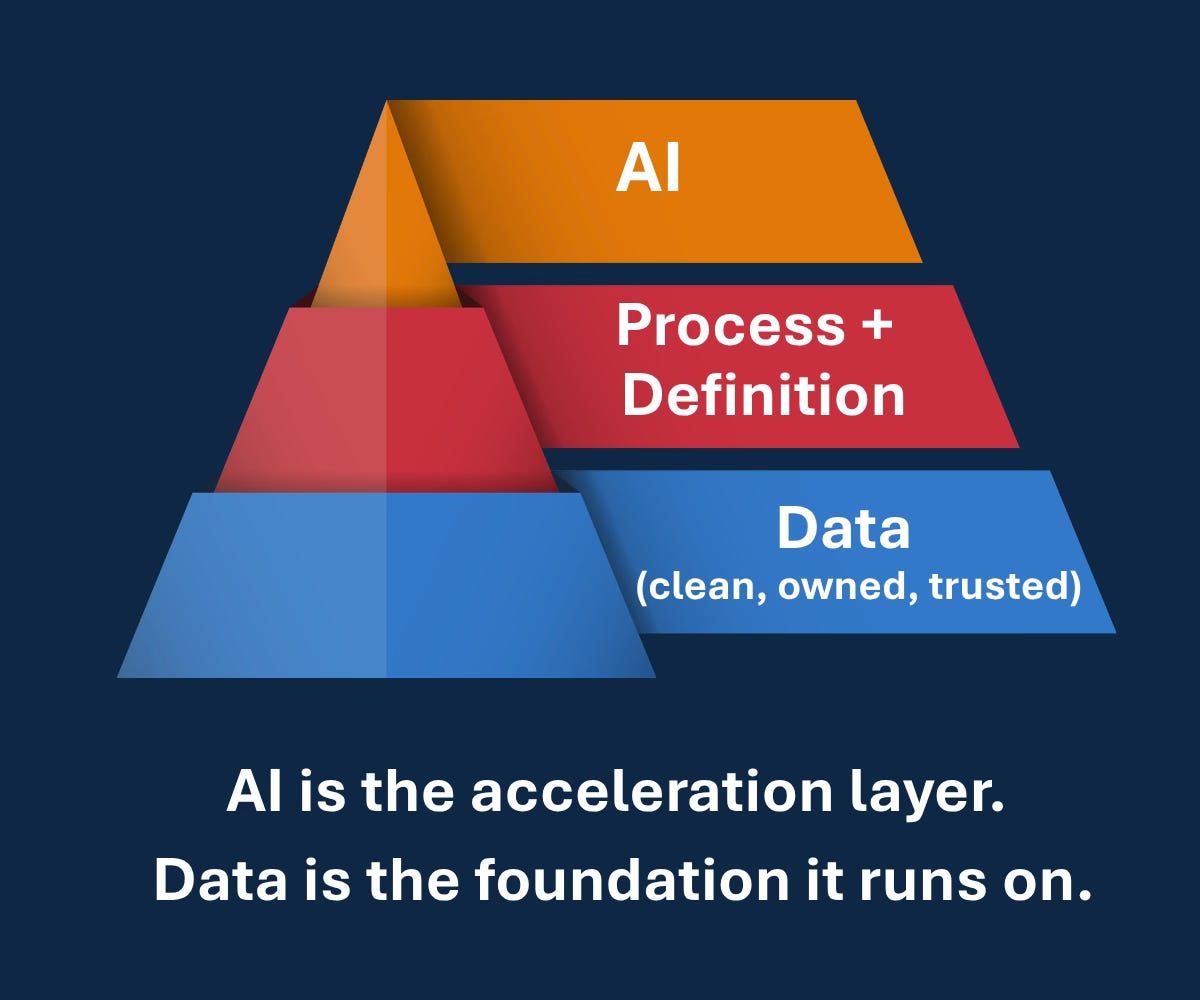
AI is not failing in finance because the models are wrong.
It is failing because the foundation underneath the models is not ready.
That distinction matters — because it changes where the work actually needs to happen.
The Pressure vs. The Reality
The pressure to adopt AI in finance is real and accelerating. Nearly 60% of finance functions now use AI in some capacity. The majority of CFOs plan to increase AI investment in 2026.
But a gap is emerging between ambition and outcome.
Only about 36% of CFOs feel confident in their ability to drive enterprise AI impact. And just 11% of finance leaders report seeing actual financial returns from their AI implementations so far.
Those numbers are not a technology problem. They are a readiness problem.
And the readiness gap almost always traces back to the same place: fragmented, inconsistent, untrustworthy data.
What AI Actually Does to Bad Data
There is a common assumption that AI will help clean up a messy data environment. That it will reconcile inconsistencies, smooth over gaps, and create clarity where there currently is none.
In practice, AI does the opposite.
It exposes inconsistencies faster. It amplifies conflicting definitions. It produces outputs that reflect — and scale — the underlying confusion.
This is why AI pilots often perform well in controlled environments and break under real-world conditions. Once exposed to fragmented data, unclear logic, and misaligned definitions, the vulnerabilities surface quickly.
For finance teams, this creates a critical constraint: if the output is not explainable and traceable, it is not usable. And if it is not usable, the investment in AI generates no return.
The Data Foundation That AI Requires
A data foundation ready to support AI is not necessarily sophisticated. But it has to be consistent, owned, and trusted.
Specifically, it means:
• A single, reconciled source of truth that finance and the business both work from
• Clear ownership of definitions. Someone is accountable when numbers diverge
• Data that is structured around the decisions that matter, not just every possible metric
• The ability to trace any output back to its source system
That last point is often the most revealing diagnostic. If you cannot trace a number in a board deck back to where it came from, you do not have a data foundation that AI can safely build on.
The Readiness Questions Worth Asking Now
Before evaluating any AI solution, these questions tend to surface the real state of data readiness quickly:
For data:
• How many systems does your FP&A team manually pull from each close cycle?
• Do finance and the business operate from the same definitions for the same metrics?
• Can you trace any number in a board deck back to its source system?
For AI:
• If you plugged an AI tool into your current data environment today, would you trust its output?
• Could your team explain to the board where an AI-generated insight came from?
• Is your data clean, unified, and reconciled enough for AI to add value, or would it just surface existing inconsistencies faster?
Honest answers to these questions do not disqualify AI adoption. They clarify where the actual starting point is.
The Sequence That Works
The organizations that see real returns from AI in finance tend to follow a consistent sequence.
They start with the foundation: clean data, consistent definitions, trusted reconciliations. They build a single source of truth before they build models on top of it. And they treat AI as the acceleration layer — not the starting point.
That is not the slow path. That is the path that does not have to be restarted.
Because the teams that skip this step do not save time. They spend it twice. Once on the AI initiative, and again on cleaning up what the AI exposed.
Data readiness is not a prerequisite that delays AI adoption. It is the prerequisite that makes AI adoption actually work.
Continue the Conversation with Arthur and Changing the Face of Finance (CFOF)
Visit CFOF Website to learn more about CFOF and our approach to finance transformation.
Subscribe to CFOF Substack to receive future episodes and executive insights.