
The FP&A Operating Model Is Broken. Budget Season Will Prove It.
Why faster tools and new platforms are not the fix most teams think they are

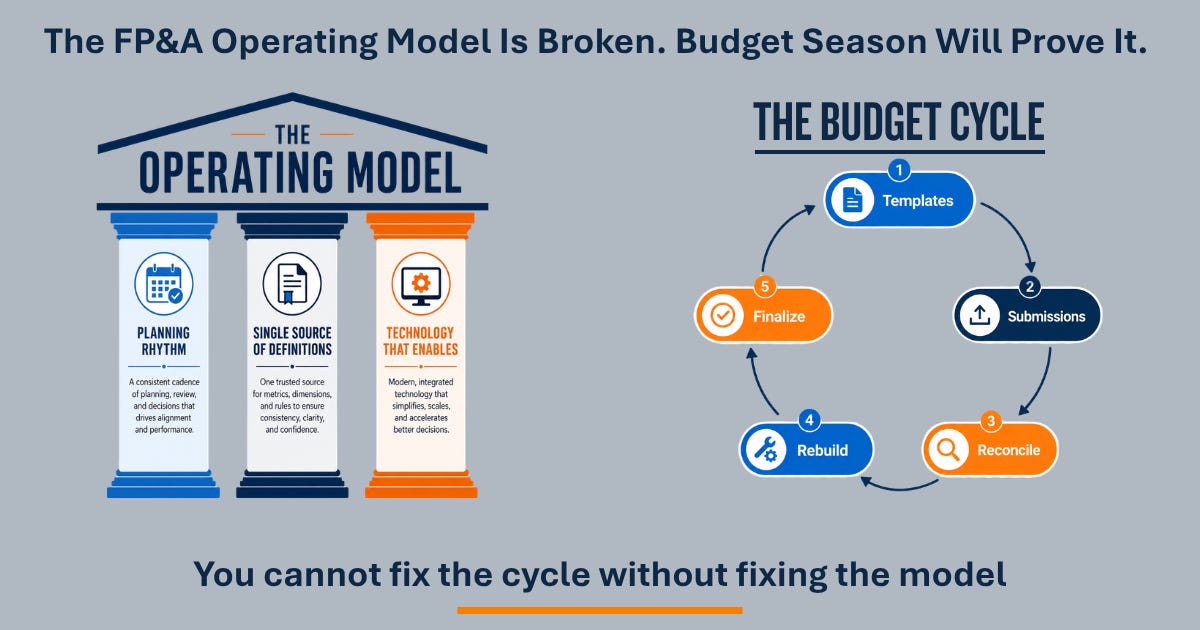
Every year, FP&A teams across the mid-market run the same cycle.
Templates go out in August. Submissions come back in September with assumptions nobody fully agrees on. October is spent reconciling. November is spent rebuilding after the first round of leadership reviews. December finalizes a plan that everyone already knows will be revised by February.
And the team calls it done.
Then the cycle starts over.
Most CFOs treat this as a calendar problem. Or a tools problem. Or a discipline problem. The natural response is to compress the timeline, buy a new planning platform, or hire more analysts.
None of those responses fix the actual issue.
Because the issue is not the calendar.
It is the operating model underneath it.
What an FP&A operating model actually is
An FP&A operating model is the structure that defines how the planning function works—across people, process, technology, and data—every period, not just at budget time.
It is the layer that determines whether a budget is a once-a-year exercise or a rolling output of a continuous planning rhythm. It is what makes the difference between FP&A as a reporting function and FP&A as a decision-support function.
Most mid-market teams do not have that layer defined. They have a budget process. They have a forecasting cadence. They have variance reporting. But the connective tissue, the operating model that makes all of it run consistently, is implicit, undocumented, and dependent on the people who happen to know how it works.
When that operating model is broken, no amount of effort fixes the cycle. Faster tools just compress the same friction into less time. A new platform just relocates the friction. A bigger team just spreads it across more people.
Five signs the operating model is the actual constraint
If most of these sound familiar, the issue is structural not tactical.
The plan depends on a single person who knows the model. When that person is out, the cycle stalls.
Functional submissions arrive with different definitions of revenue, headcount, or contribution. Reconciliation is the bulk of the work.
Reviews focus on the numbers, not the assumptions underneath them. Disagreements surface late.
Forecast updates are point-in-time exercises, not a continuous output of how the business is actually running.
The system of record is a spreadsheet. The planning platform, if there is one, is a layer on top of that spreadsheet.
Each of these is symptomatic of an FP&A function that is doing the work without a defined model for how the work should run.
What an actual operating model requires
Three things have to be in place.
First, a defined planning rhythm. Not just budget season but a year-round cadence with clear inputs, clear outputs, and clear ownership for each cycle. Monthly reforecasts that actually change behavior. Quarterly strategic reviews that connect to the plan. An annual budget that is the result of the rhythm, not the disruption of it.
Second, a single source of definitions. Every team running the plan needs to agree on what revenue means, what headcount counts as, what the contribution margin includes. Without that, every submission becomes a reconciliation exercise and the team spends more time aligning data than analyzing it.
Third, technology that enables the model rather than defining it. Most FP&A teams either over-rely on spreadsheets or over-invest in platforms before the underlying model is clear. Both fail. The right sequence is operating model first, technology second.
Why budget season will prove this
Budget season is the annual stress test for the FP&A operating model. Every weakness in the structure gets exposed under the pressure of the timeline.
If definitions are inconsistent, budget season will expose it. If ownership is unclear, budget season will expose it. If the planning rhythm only exists during budget season, budget season will reveal that there is no rhythm at all.
The teams that get through it cleanly are not the ones with the best tools or the largest analyst headcount. They are the ones whose operating model was already running before August.
Everyone else is rebuilding the model in real time, while also producing the plan.
That is the trap most mid-market FP&A teams are in.
The AI dimension that is about to make this worse
AI is being marketed heavily into FP&A right now. Forecasting models. Variance explanations. Scenario generation. Anomaly detection.
These capabilities are real. But they only work on top of a consistent operating model.
AI cannot reconcile definitions the organization has not agreed on. It cannot produce reliable variance explanations when the underlying data definitions shift across functions. It cannot accelerate planning cycles that have no defined rhythm to begin with.
The teams positioned to benefit from AI in FP&A are the ones who built the operating model first. Everyone else will spend the next two years discovering that AI amplifies whatever it lands on and an inconsistent operating model gets amplified faster than a consistent one.
Where mid-market teams have an advantage
Large enterprises have years of accumulated FP&A complexity. Multiple legacy systems. Multi-layer organizational structures. Years of customizations that have to be unwound before a clean operating model can be defined.
Mid-market teams have a real structural advantage.
Fewer functions to align. Shorter feedback loops. Closer relationships between FP&A and the operating teams. The ability to define an operating model deliberately before the organization gets large enough to make it hard.
The mid-market opportunity is not to scale up like a large enterprise. It is to build the operating model correctly while the organization is still small enough for that work to be done in months, not years.
Where to start
Before the budget cycle starts, three questions are worth answering as a leadership team.
What is the actual planning rhythm and is the team running it, or only running budget season?
Where are the definitions inconsistent across functions, and what would it take to align them before the next cycle?
Is the technology stack enabling the operating model, or is the operating model being shaped by the limitations of the tools?
Those three questions will tell you more about your FP&A function than any benchmarking report.
And they are the starting point for fixing the cycle not just running it again.
Continue the Conversation with Arthur and Changing the Face of Finance (CFOF)
Visit the CFOF Website to learn more about CFOF and our approach to finance transformation.
Subscribe to CFOF Substack to receive future episodes and executive insights.