
The Analytics Translator: Finance's Most Underbuilt Role
Why every data-driven finance team needs the role they keep skipping

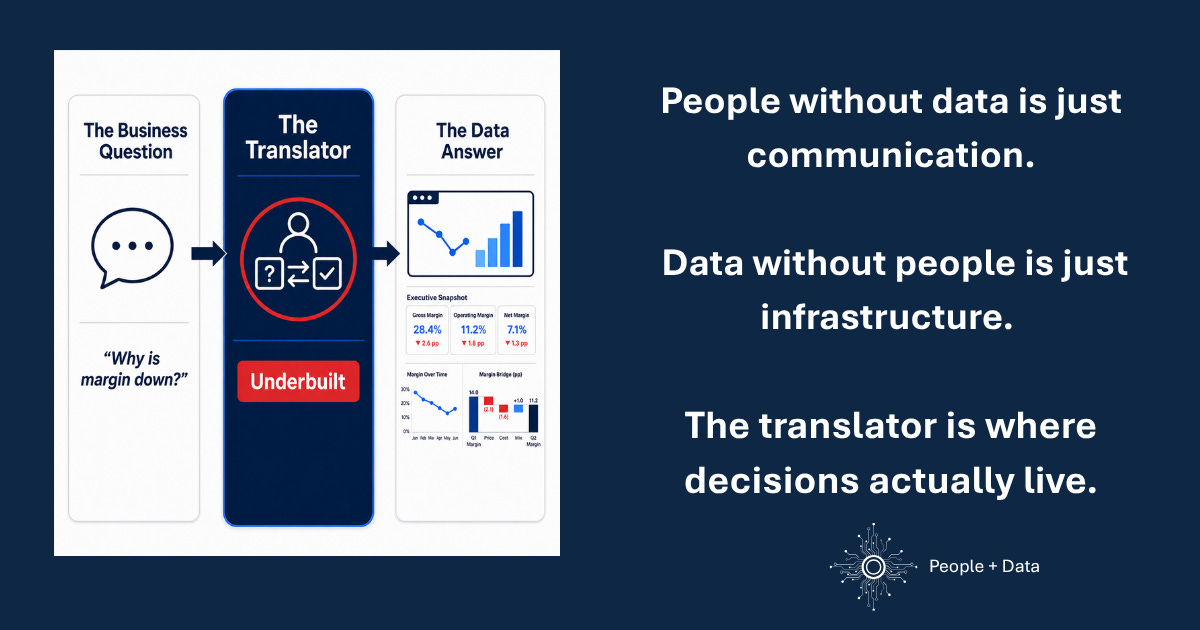
Every CFO I talk to wants the same thing. A finance function that moves at the speed of the business, with data that informs decisions instead of explaining them afterward. The aspiration is consistent. The investment patterns are not.
Most finance teams have built two of the three roles required to get there. They have analysts who can pull data. They have leaders who can ask sharp questions. And in between, they have a gap where the third role should be.
That role is the analytics translator. And finance keeps under-hiring for it.
What the translator actually does
The analytics translator sits between the business question and the data answer. The role is not about running queries faster or building better dashboards. It is about converting ambiguous business questions into structured analytical work, and converting the result back into something a decision-maker can act on.
When a CFO asks why margin is down in the East region, the translator decides what question that actually is. Is it pricing? Mix? A specific account? A timing issue? Each of those is a different analysis. The translator scopes it, partners with the analyst who can execute it, and brings back an answer framed as a decision, not a number.
Without that role, two failure modes show up. Analysts produce technically correct work that does not answer what was really being asked. Or leaders make decisions on incomplete answers because nobody had time to dig deeper into the question behind the question.
Why finance keeps skipping it
Three reasons usually.
First, the role does not fit cleanly into existing job families. It is not an analyst. It is not an FP&A manager. It is not a data engineer. So when budgets get built, the slot does not exist on the template, and the work gets absorbed by whoever has the bandwidth to fail at it.
Second, the value is hard to measure in advance. A good translator prevents bad decisions and accelerates good ones, both of which are invisible in a year-end review. So the role gets cut first when capacity gets tight.
Third, finance leaders assume the work is happening organically. It usually is not. It is happening in fragments across three people, none of whom were hired for it, and all of whom are spending evenings on it instead of the work they were actually hired to do.
Where it fits in the Compass
In Compass terms, the analytics translator lives at the intersection of two dimensions. The People dimension defines the role, the skills, and the reporting line. The Data dimension defines the capabilities, definitions, and analytics layer the translator works against.
Neither dimension produces a translator on its own. People without data give you a great communicator with nothing to translate. Data without people gives you a capable platform nobody is using to shape decisions. The role exists where both dimensions are intentional.
The bottom line
Finance teams that want to be data-driven need to staff for it. That means hiring or developing the role that translates between the business and the data, and defining what that role owns inside the operating model.
Until that role exists, the gap between aspiration and execution stays exactly where it has always been.
In the middle.
Data only becomes valuable when it changes decisions. The hardest part isn't building dashboards. It's translating analysis into actions that improve outcomes.
This seems similar to the “techno functional“ role in IT.
The guys and gals who know technology, but also understand the business side. Who ask the questions to get the right answers.
I suspected this is similar to the CRO role in which companies expect the CRO to wear multiple hats so as to also be the head of sales - when they are actually two distinct positions.