
How I’m Using AI Across Accounting, Finance, Consulting, and Thought Leadership
Originally submitted to Today's CPA — the unedited author's version, in full.

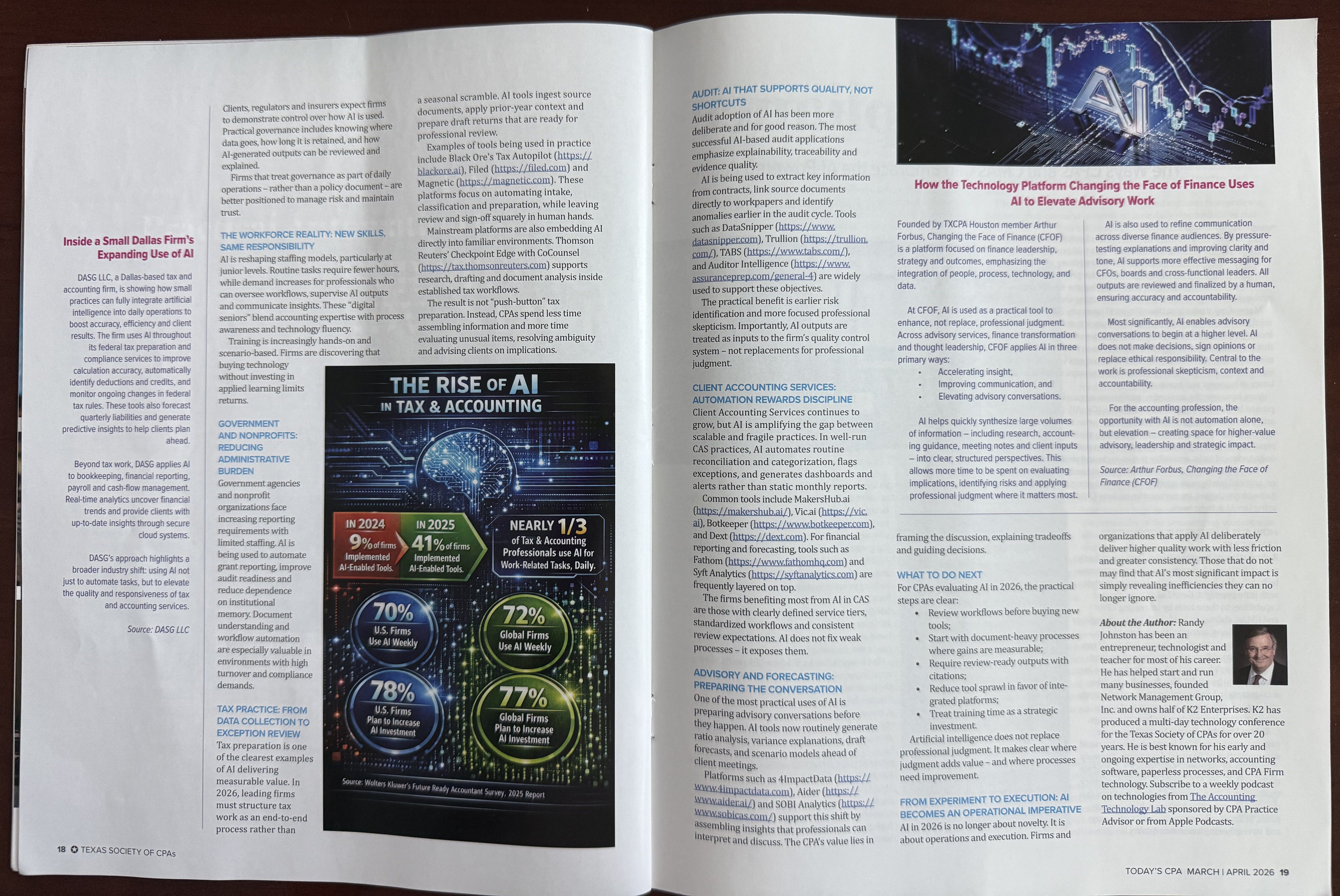
Editor’s note from Arthur — May 2026
Earlier this year, the Texas Society of CPAs invited members to contribute short perspectives on practical AI use in the profession. I submitted the piece below. It was selected for publication in the March/April 2026 issue of Today’s CPA, where it ran alongside the magazine’s broader feature on the rise of AI in accounting.
The published version is excellent and worth reading, you can find it here on tx.cpa. The version below is my original submission as written, including the full title, structure, and AI disclosure as I intended them. I’m sharing it here because I think the original framing of accelerating insight, improving clarity, and elevating the advisory starting point, captures something worth preserving in the author’s voice.
Earlier in my career, I practiced as a licensed CPA and spent decades working alongside CFOs, controllers, and finance leaders across accounting, finance, and transformation initiatives. Today, while I am no longer a licensed CPA, I remain actively engaged in the profession as a member of Texas Society of CPAs (TXCPA) and TXCPA Houston, including service on the CFO Controllers Peer Group Committee and the Accounting Disciplines Committee. I am also the founder of Changing the Face of Finance (CFOF), a platform focused on finance leadership, strategy, and outcomes.
Across my work today, spanning advisory services, finance transformation, and thought leadership, artificial intelligence has become a practical, everyday tool. Not as a replacement for professional judgment, but as a capability that expands capacity, sharpens thinking, and improves the quality of decision-oriented conversations.
I primarily use AI in three ways: accelerating insight, improving clarity, and elevating the advisory starting point.
Accelerating Insight Without Replacing Judgment
AI significantly reduces the time it takes to move from raw information to informed understanding. I use it to synthesize large volumes of unstructured material, meeting notes, research, accounting guidance, internal documentation, and client inputs, into concise summaries and structured perspectives. This allows me to spend less time organizing information and more time evaluating implications, identifying risks, and applying judgment where it matters most.
AI does not validate conclusions for me. It shortens the path to the point where professional judgment becomes essential.
Improving Communication Across Finance Audiences
A core responsibility of finance leaders is translating complexity into clarity. I use AI to pressure-test explanations, refine messaging, and adapt language for different audiences such as CFOs, controllers, boards, and cross-functional leaders. In this role, AI functions as a drafting and refinement tool, helping improve precision and tone.
Nothing is shared without review. The final message remains human-led, but the process is more efficient and intentional.
Elevating Advisory Conversations
Through CFOF, my work often focuses on helping finance leaders navigate the intersection of strategy, people, process, technology, and data. AI supports this by identifying patterns, surfacing blind spots, and exploring scenarios that merit deeper discussion.
As a result, advisory conversations can start at a higher level focused on outcomes, tradeoffs, and leadership decisions rather than mechanics. Accountability remains human, but the thinking is broader and better informed.
What AI Does Not Do
AI does not make decisions, sign opinions, or replace ethical responsibility. Professional skepticism, context, and accountability remain central to the work. Every AI-assisted output is reviewed, validated, and contextualized before it influences a recommendation or discussion.
The Opportunity for the Profession
For the accounting profession, the true value of AI is not automation alone - it is elevation. By removing low-value friction, AI creates space for higher-value work: advising, leading, and shaping outcomes. Professionals who treat AI as a thinking partner rather than a shortcut will be best positioned for what comes next.
AI Disclosure
This article was developed with the assistance of artificial intelligence as a drafting and refinement tool. All content reflects the author’s experience, judgment, and final editorial review.
Short Author Bio
Arthur Forbus is the founder of Changing the Face of Finance (CFOF), a platform for thought leadership and strategic advisory services focused on finance leadership and outcomes. A former practicing CPA, Arthur has worked with CFOs, CIOs and finance leaders for nearly four decades across accounting, finance transformation, and advisory roles. He is a member of the Texas Society of CPAs and TXCPA Houston and serves on the CFO Controllers Peer Group Committee and the Accounting Disciplines Committee.